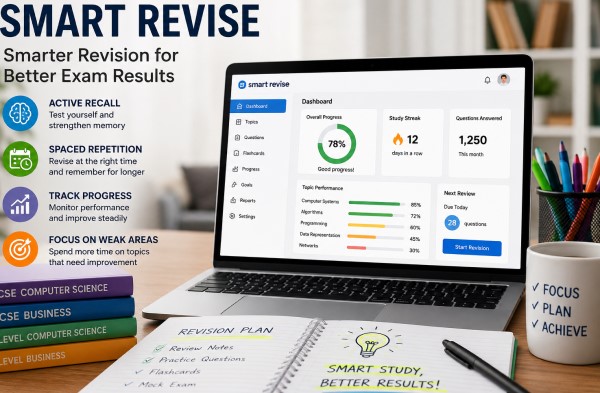
In today’s competitive academic environment, students are constantly searching for effective ways to improve their learning, retain information, and achieve better examination results. Traditional revision methods such as rereading textbooks and highlighting notes often fail to deliver long-term retention. This is where smart revise has emerged as a game-changing solution.
Smart revise is a modern revision approach and learning platform designed to help students study more efficiently rather than simply spending more hours revising. By using evidence-based learning techniques, personalised study plans, and intelligent question systems, smart revise enables learners to focus on their weak areas while reinforcing their strengths.
This article explores what smart revise is, how it works, its key features, benefits, and why it has become a valuable resource for students preparing for examinations.
What Is Smart Revise?
Smart revise is an innovative digital revision system that helps students prepare for examinations through active recall, spaced repetition, and personalised learning. Unlike traditional revision methods that often rely on passive reading, smart revise encourages students to engage actively with study materials.
The platform analyses student performance and adjusts revision activities accordingly. This personalised approach ensures that learners spend more time reviewing topics they find difficult while reducing time spent on concepts they already understand.
The primary goal of smart revise is to improve knowledge retention and maximise examination performance through scientifically proven learning strategies.
Why Traditional Revision Methods Often Fail
Many students spend hours revising but still struggle to remember information during examinations. This problem often occurs because traditional study methods rely heavily on passive learning.
Common ineffective revision habits include:
- Reading notes repeatedly
- Highlighting large sections of text
- Copying information without understanding it
- Cramming before examinations
While these techniques may create the feeling of productivity, they often fail to promote long-term memory retention.
Smart revise addresses these challenges by encouraging active participation in the learning process, making revision more effective and efficient.
How Smart Revise Works
The smart revise system uses educational psychology principles to help students learn more effectively.
Active Recall
Active recall requires students to retrieve information from memory rather than simply reading it. Research consistently shows that recalling information strengthens memory pathways and improves retention.
Smart revise uses quizzes, questions, and challenges that require students to actively remember information, helping knowledge remain accessible for longer periods.
Spaced Repetition
Spaced repetition involves reviewing information at carefully planned intervals. Instead of studying a topic repeatedly in one session, students revisit it over time.
Smart revise automatically schedules review sessions based on individual performance. Topics that students find difficult appear more frequently, while mastered concepts are reviewed less often.
Personalised Learning
Every student learns differently. Smart revise tracks progress and identifies strengths and weaknesses. The system then creates a customised revision pathway tailored to each learner’s needs.
This targeted approach allows students to maximise their revision time and focus on areas that require improvement.
Key Features of Smart Revise
The popularity of smart revise can largely be attributed to its powerful features.
Intelligent Question Banks
Smart revise contains extensive collections of examination-style questions designed to test knowledge and understanding.
These questions help students:
- Practise exam techniques
- Improve confidence
- Identify knowledge gaps
- Strengthen subject understanding
Progress Tracking
One of the most valuable features is the ability to monitor progress over time.
Students can view:
- Completed revision sessions
- Topic mastery levels
- Performance trends
- Areas requiring improvement
This feedback helps learners stay motivated and focused on their goals.
Adaptive Learning Technology
The platform continuously analyses performance and adjusts future revision activities.
For example, if a student struggles with a particular topic, smart revise increases the frequency of related questions until confidence improves.
Performance Reports
Detailed reports provide valuable insights into learning habits and academic progress.
These reports can assist:
- Students
- Teachers
- Parents
By identifying strengths and weaknesses early, users can take action before examinations.
Benefits of Using Smart Revise
The growing popularity of smart revise is supported by numerous educational benefits.
Improved Memory Retention
The combination of active recall and spaced repetition significantly improves long-term memory retention.
Students are more likely to remember information during examinations because they have repeatedly retrieved and reinforced it over time.
Greater Revision Efficiency
Rather than spending hours reviewing familiar content, smart revise focuses attention on weaker areas.
This targeted approach allows students to achieve better results with less wasted effort.
Increased Confidence
Confidence plays a major role in examination success.
As students answer more questions correctly and track their progress, they gain confidence in their abilities and approach examinations with a positive mindset.
Reduced Exam Stress
Many students experience anxiety before examinations due to uncertainty about their preparation.
Smart revise helps reduce stress by providing clear evidence of progress and readiness, allowing students to approach assessments more calmly.
Smart Revise for GCSE Students
GCSE examinations represent a crucial stage in a student’s academic journey.
Smart revise is particularly beneficial for GCSE students because it:
- Covers large amounts of content systematically
- Supports multiple subjects
- Reinforces knowledge regularly
- Improves examination technique
Students can create structured revision schedules and ensure every topic receives appropriate attention before examinations.
Smart Revise for A-Level Students
A-Level courses often involve greater complexity and deeper subject understanding.
Smart revise supports advanced learners by:
- Encouraging critical thinking
- Strengthening long-term retention
- Providing challenging examination-style questions
- Identifying gaps in understanding
This support can be especially valuable when preparing for university entrance and competitive academic programmes.
How Teachers Benefit from Smart Revise
While students are the primary users, teachers also gain significant advantages.
Monitoring Student Progress
Teachers can track individual and class performance through detailed analytics.
This allows educators to identify:
- Common misconceptions
- Struggling students
- High-performing learners
- Areas requiring additional teaching
Targeted Intervention
The data generated by smart revise enables teachers to provide personalised support where it is needed most.
This can improve classroom outcomes and overall student achievement.
Assignment Management
Teachers can assign revision tasks and monitor completion rates, ensuring students remain engaged throughout the academic year.
Tips for Getting the Most from Smart Revise
To maximise the benefits of smart revise, students should follow a few simple strategies.
Revise Consistently
Short daily revision sessions are generally more effective than long, infrequent study periods.
Consistency helps reinforce learning and prevents last-minute cramming.
Focus on Weak Areas
Pay close attention to topics identified as challenging by the system.
Improving weak areas often leads to the greatest overall performance gains.
Complete Regular Practice Questions
The more questions students attempt, the more opportunities they have to strengthen memory and improve examination technique.
Review Progress Reports
Regularly analysing performance reports helps students understand their development and adjust their study strategies accordingly.
The Future of Smart Revision Technology
Educational technology continues to evolve rapidly. Future developments in smart revise systems are likely to include:
- Advanced artificial intelligence
- Enhanced personalisation
- Real-time learning analytics
- Interactive study experiences
- Predictive performance modelling
These innovations will further improve learning outcomes and make revision more engaging for students.
As technology becomes increasingly integrated into education, intelligent revision platforms are expected to play a central role in academic success.
Conclusion
Smart revise represents a significant advancement in modern learning and examination preparation. By combining active recall, spaced repetition, adaptive learning, and detailed progress tracking, it offers a highly effective alternative to traditional revision methods.
Students who use smart revise can benefit from improved memory retention, greater confidence, reduced stress, and more efficient study habits. Teachers also gain valuable insights that support targeted instruction and student development.
As educational demands continue to increase, smart revise provides a practical and evidence-based solution for learners seeking to achieve their full academic potential. Whether preparing for GCSEs, A-Levels, or other qualifications, smart revise has become an essential tool for smarter learning and better examination results.